
Glendale, Arizona
Antique Clock Repair in Glendale, AZ
Careful, conservation-minded repair for 18th, 19th and early 20th century clocks. Trusted craftsmanship for antique clocks throughout Glendale and the West Valley.
- Experienced Clock Technicians
- Antique Clock Specialists
- Precision Repairs
- Honest Pricing
- Quality Craftsmanship
Professional Antique Clock Repair You Can Trust
Wyattviano Co. provides specialist antique clock repair from our bench at 5720 W Frier Dr in Glendale, Arizona. We work on antique clocks every week, and that repetition matters: a technician who sees the same families of movements year after year recognises a fault in minutes that a generalist might chase for hours. Antique movements were made before interchangeable parts existed, so every wheel, pinion and lever was fitted by hand to its neighbours.
Every clock that arrives here is treated as an individual object with its own history. We photograph it on intake, note the maker, the serial or batch numbers, the case condition and any previous repairs. That record travels with the clock through the workshop and is handed back to you at collection, so you always know exactly what was done and why.
Our work on antique clocks covers the full range, from a simple adjustment that takes twenty minutes to a complete overhaul involving hand-cut brass wheels, tapered steel pivots, verge and anchor escapements, catgut lines, and hand-forged suspension springs. We quote before we begin, we do not add work without your approval, and we tell you plainly when a repair is not worth the money.
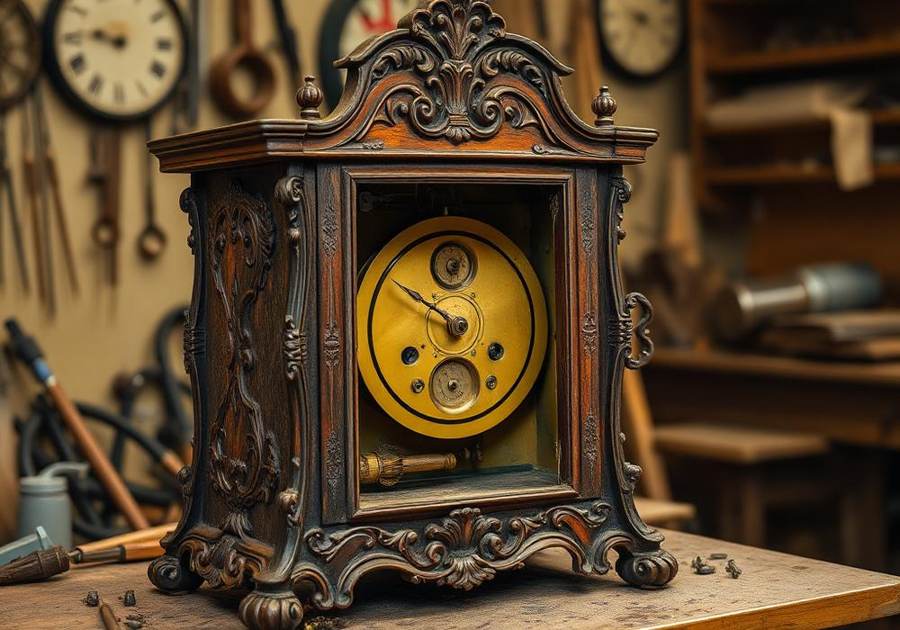
Signs Your Clock Needs Professional Attention
Mechanical clocks rarely fail without warning. They give you months, sometimes years, of small signals before they stop altogether, and the owners who act on those signals pay far less than the owners who wait. If you recognise any of the following in your clock, it is time to call us.
- the clock runs for a few hours and then stops
- the strike train counts the wrong hour
- the pendulum swings unevenly or falls out of beat
- the winding arbor slips or feels gritty
- the hands bind against the dial or each other
Any one of these symptoms on its own is a maintenance issue. Two or three together usually mean the movement has been running dry long enough that the pivots are wearing into the plates, and at that point the repair changes from a cleaning to an overhaul with bushing work. Calling early is genuinely cheaper.
If your clock has already stopped, resist the temptation to keep winding it or to force the hands. Stop the pendulum, leave the weights or springs where they are, and call (623) 847-5184. A stopped clock does no further harm; a forced clock can break a wheel tooth in a second.
Our Antique Clock Repair Process
We follow the same disciplined sequence on every clock, because shortcuts in horology always reappear as callbacks. Here is what happens after you approve the estimate.
- Documented intake and photography of the movement, dial, case and all original markings
- Full disassembly with each component logged so the movement returns exactly as it was built
- Ultrasonic and hand cleaning with solutions chosen for the alloys present
- Pivot polishing and bushing of every worn bearing hole using brass matched to the original plate
- Mainspring inspection, replacement where fatigue is measurable, and correct barrel lubrication
- Escapement adjustment, beat setting, and a minimum fourteen-day regulation run on the test stand
The fourteen-day test run at the end deserves special mention. A clock can look perfect on the bench and still fail after three days as the oil settles and the mainspring relaxes. We would far rather find that here than in your living room, so nothing leaves the workshop until it has proved itself over time.
Throughout the process you are welcome to call for an update. Clock work rewards patience, and we would rather explain a delay than rush a job that will need doing twice.
What Makes Our Approach Different
There is a shortcut in this trade that we refuse to take: spraying a movement with penetrating oil, wiping the outside, and sending it home. It buys a few months and destroys the pivots. Every antique clock we service is fully disassembled, cleaned, inspected part by part and reassembled with the correct oils applied to the correct points in the correct quantities.
We also believe in reversibility. Wherever possible, the work we do can be undone by a future restorer without loss, and original components are retained and returned to you rather than discarded. Heirloom clocks outlive all of us, and the person who services yours in 2070 should be able to read what we did.
Finally, we explain things. Owners who understand why a clock needs to be level, why it must be in beat, and how the mainspring stores energy take better care of their clocks and call us less often. That is the point.
Antique Clock Repair Costs and Estimates
Assessment & Estimate
Free
Inspection, diagnosis and a written explanation of what your clock needs.
Adjustment & Tune-Up
Entry level
Beat setting, regulation, minor adjustment and owner instruction, often completed in a single visit.
Clean, Oil & Service
Mid range
Full disassembly, cleaning, inspection, correct lubrication and a fourteen-day test run.
Complete Overhaul
Investment
Everything above plus bushing, pivot polishing, mainspring work and part fabrication where needed.
Because no two clocks are alike, we do not publish fixed prices. Call (623) 847-5184 for a free, honest estimate on your antique clock.
Serving Glendale and the Entire West Valley
Our workshop is in Glendale, and we serve Glendale, Phoenix, Peoria, Surprise, Sun City, El Mirage, Tolleson, Avondale, Goodyear and Litchfield Park along with the surrounding Maricopa County communities. Customers regularly drive to us from across the Valley, and for larger clocks we come to you.
House calls are a substantial part of our antique clock repair work. If your clock is a longcase, a heavy wall regulator, or anything built into the fabric of the home, please do not attempt to move it. Read our grandfather clock moving guide first, then call us to arrange a visit.
Whichever city you are in, the standard of work is identical: careful diagnosis, honest pricing, and a clock that runs reliably when it goes home.
Ready to Restore Your Clock?
Call now for expert antique clock repair in Glendale, AZ, or request a free written estimate online.
Caring for Your Clock After Service
A serviced clock still needs an owner who knows what it likes. Wind at the same time each week rather than waiting for the clock to run down, and turn the key smoothly to the stop without forcing it. Set the hands forward through the chimes rather than backwards, pausing at each strike to let it complete.
Keep the clock away from direct sunlight through south-facing Arizona windows, and away from air conditioning vents that blast dry, dusty air straight into the case. Dust is the enemy of a clock movement, because dust plus oil equals grinding paste.
Finally, note the date of service somewhere safe and plan the next one. Our clock maintenance schedule lays out sensible intervals for each type of clock in the desert climate.
Frequently Asked Questions
How much does antique clock repair cost in Glendale?
Estimates for antique clocks depend on the movement, the fault and the condition of the case. Simple adjustments are modest, a full clean and oil sits in the middle, and a complete overhaul with bushing and part fabrication costs more. Every clock receives a free estimate first, so you always know the number before we begin.
How long will my antique clock be in the workshop?
A standard service is usually two to three weeks, which includes a mandatory fourteen-day test run before the clock is released. Restorations that require case work or fabricated parts take longer, and we give you a realistic timeline in writing with the estimate.
Do you offer house calls for antique clocks?
Yes. Where the clock is too large, too fragile or too awkward to transport, we service it in your home. We cover Glendale, Phoenix, Peoria, Surprise, Sun City, El Mirage, Tolleson, Avondale, Goodyear and Litchfield Park.
Can you find parts for an old or unusual clock?
In most cases, yes. We hold a large stock of period-appropriate components, work with specialist suppliers, and fabricate wheels, pinions, levers and springs on the bench when nothing suitable exists. Very few clocks are genuinely unrepairable.
Will the repair reduce the value of my antique clock?
Correct, conservation-minded work protects value; poor work destroys it. We retain original parts, avoid irreversible modifications, and document everything. If a proposed repair would affect collectible value, we tell you before we do it.
How often should antique clocks be serviced?
Plan on a full clean and oil every five to seven years, with light maintenance in between. In Arizona's dry heat, oils evaporate faster than the manufacturers ever anticipated, so the shorter end of that range is usually the safer choice.
What areas do you cover for antique clock repair?
We serve Glendale, Phoenix, Peoria, Surprise, Sun City, El Mirage, Tolleson, Avondale, Goodyear and Litchfield Park and the wider Maricopa County area from our Glendale workshop at 5720 W Frier Dr.
Request Service or a Free Estimate
Tell us about your clock and we will respond with honest guidance and a written estimate. Prefer to talk it through? Call (623) 847-5184.